
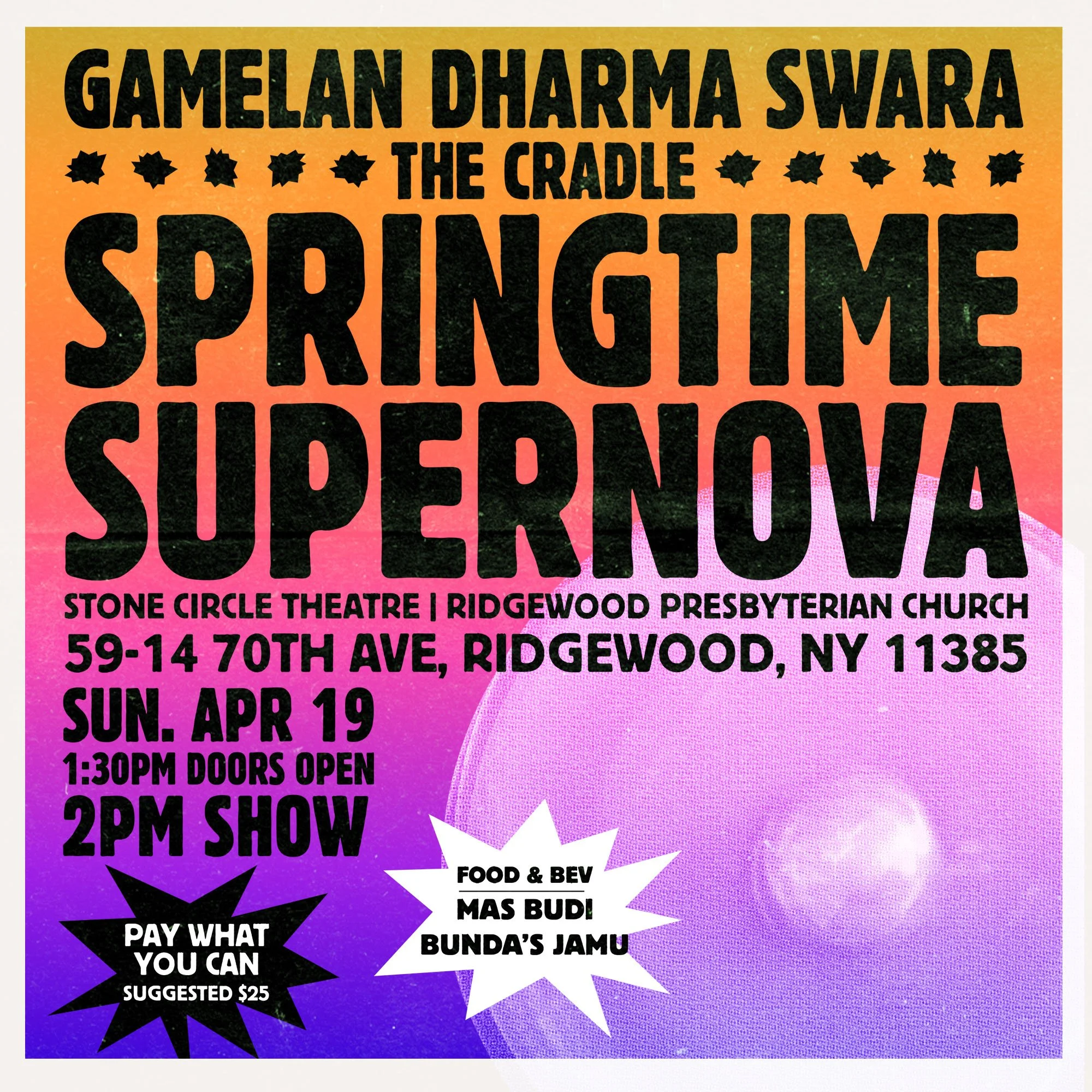
SPRINGTIME SUPERNOVA
Sunday, 19th april 2026
STONE CIRCLE THEATRE - 2PM
@ Ridgewood Presbyterian Church
THE CRADLE | GAMELAN DHARMA SWARA
MAS BUDI STREET FOOD | BUNDA’S JAMU
Today’s program will be approximately 2 hours with a brief intermission.
PROGRAM
THE CRADLE
“Singing about bikes, bugs, and fragile human connection, the Brooklyn songwriter helms a modern, ecstatic New York City folk album...An overarching theme of ‘Down on Them’ is the possibility of softness, of humanity, in a world that so often inspires division. ”
- intermission -
GAMELAN DHARMA SWARA
PAGAR AYU
I Gusti Nyoman (Komin) Darta, Composer
Shoko Yamamuro, Choreographer
2024
SAPTA BHUANA
I Gusti Bagus Suarsana 1970
MERAK NGELO
Gender Wayang Ensemble
Traditional
REBONG
Gender Wayang Ensemble
Traditional
NOR’EASTER
Joel Mellin, Composer 2018
Ilona Bito & Ndaru Kartikaningsih, Choreographers 2019-25
WIRANATA
I Nyoman Kaler 1942
revised I Nyoman Ridet 1945
PROGRAM NOTES
PAGAR AYU
Co-created by Artist-in-Residence, Gusti Komin and longtime Balinese dance teacher and choreographer, Shoko Yamamuro, the traditional welcome piece to open a performance is reimagined. Works of this genre — typically in the female style — often focus on notions of reception and invitation alongside purification and blessing. This exploratory work will however, also consider the group's identity as New Yorkers performing Balinese arts via the lens of expatriate artists — with the vast majority in the ensemble not being ethnically Balinese, nor having spent time in Bali. Shifts in the concepts of gender, style, and movement are explored, with the artists drawing simultaneously from Balinese roots and the freedom afforded by their émigré experience, in an introspective and ultimately, celebratory work. The piece vibrates from deep, underground to soar high above in the sky, with ideas of aspiration, lightness and beauty alongside those of grittiness and toughness, work and preparedness. The co-creators worked remotely to each other (New York and California, respectively) to form a uniquely responsive piece to persona, distance and context.
SAPTA BHUANA
Originally from Buleleng, the composer I Gusti Bagus Suarsana wrote many gong kebyar kreasi in the late 60s for the renowned gamelan group Abdi Budaya, in the remote village of Perean in Tabanan, Bali. Many of these works, including Sapta Bhuana, were eventually captured on cassette recordings in the 1980s, and helped establish Abdi Budaya's mythic and worldwide reputation for achieving exceedingly fast speeds. The recordings captured the attention of American composer and educator Wayne Vitale, who spent time living and studying with Abdi Budaya in the 1990s and once measured their performance of Sapta Bhuana at an impressive 600 hits per minute at its peak.
While Sapta Bhuana as a composition typifies the "Perean style", it also exemplifies the concept of musical authorship in Bali, where ideas are constantly borrowed, recontextualized and juxtaposed with entirely new material. In this case, musical phrases from the gegenderan (opening section) of another kebyar work Sekar Gendot, have been appropriated but, ultimately produce an entirely different and original result.
Interpreted loosely as the "seven sounds of the world", Sapta Bhuana continues to be a signature piece in Abdi Budaya's repertoire, and has now been passed down over two generations of musicians. Dharma Swara is grateful to have the opportunity to refine its performance of Sapta Bhuana with Abdi Budaya when they visit Bali in 2026. It was honestly maniacal for Dharma Swara to attempt to learn it. But it's really fun.
GAMELAN GENDER WAYANG
Gender Wayang is an ancient style of gamelan music that often accompanies wayang (shadow puppet theatre) and most sacred Balinese Hindu rituals such as cremations and tooth filing ceremonies. The smallest of the gamelan ensembles, it requires only two players and is complete at four, the additional instruments doubling an octave above. It is considered to be the most complex music with elaborate kotekan (interlocking configurations) in both odd and even meters which must synchronise with their partner’s music. The hands are constantly playing contrapuntally. Damping is difficult and done with the outer part of the fourth and fifth fingers. The music has a resonating, shimmering and vibrating quality rich in overtones which is created by striking bronze keys with wooden mallets, all within the framework of pentatonic slendro tuning.
NOR’EASTER
A new work by American composer and Jerome Fund awardee Joel Mellin featuring original choreography by Dharma Swara dancers Ilona Bito and Ndaru Kartikaningsih. The piece is inspired by the awe and wonder embodied by a child immersed in the experience of a uniquely powerful—and North Atlantic—storm.
“The Nor’easter is a snow storm of extreme and damaging conditions, but when it’s gone, leaves blankets of glistening, white snow and the calmness that nature brings after difficult times. I see enduring this phenomenon as uniquely characteristic of growing up in New England, but there are parallels to life on the stormy island of Bali, Indonesia, where torrential storms are frequent. The storm is a universal metaphor for clashing styles, cultural exchange, and the unity that is created by melding seemingly disparate constructs.”
— Joel Mellin
Gamelan Dharma Swara was supported by New Music USA’s Organisation Fund in 2024-25
WIRANATA
Tari Wiranata is a non-narrative dance piece that portrays the ideal qualities of a king or a protector of people: boldness, strength, and courage. The dance is said to have been created by I Nyoman Kaler, one of Bali’s earliest and most famous kebyar dancers and teachers, and later revised by his student, I Nyoman Ridet. Popularised by the beloved bebancian* dancer Jero Gadung and typically performed by women, Wiranata features several unique choreographic features, including intensely darting and snaking eye movements, and a characteristic flipping of the dancers’ wrists. The Wiranata being presented today is a version taught by revered bebancian dancer and teacher Agung Oka Partini.
*Bebancian is a category of Balinese dance in which the character is depicted as neither stereotypically male or female, but rather, a third, neutral gender. Utilising aspects of both male and female dance techniques, the dancers quickly alternate between refined grace and aggressive sharpness.
ABOUT THE CRADLE
Paco Cathcart is a Colombian-American musician and writer from Brooklyn, New York who has performed and recorded mostly under the moniker “The Cradle” since around 2013. In that time they have toured extensively in the United
States and internationally, and put out 17 full length albums, as well as many more EPs and live tapes, on various indie labels. In May of 2025 their most recent LP Down on Them was released on Wharf Cat Records.
ABOUT JOEL MELLIN
“…Mellin is a prism for musical ideas. No matter how complicated or difficult to master an instrument is, he’ll find a way to make it work within a piece of music.”
Joel Mellin is a Ridgewood, Queens-based multidisciplinary artist whose exploratory career has taken him from NASA space science engineering to studying with the musicians in the remote villages of Bali, Indonesia. He is a composer, musician, sound artist, installation artist, visual artist, and instrument builder.
While his work bridges disciplines and defies easy categorization, the same core principles run through-out: curiosity, creativity, and a deep understanding and commitment to process. He has developed immersive 3D sound environments to realize audio tornados, evolved language with genetic algorithms, scored thunderstorms, and developed innovative tools for deconstructing and reconstructing digital audio. In 2020 he founded the ambient psychedelic group, numün, with fellow Dharma Swara member Chris Romero and ambient country pioneer Bob Holmes (SUSS).
His work has been performed in the US at the Smithsonian Institute (DC), the Princeton Festival (NJ), the Chocolate Factory Theater, The Kitchen, Ronald Feldman Gallery, Hartwick College, Adelphi University, and the Gershwin Hotel (NY). Internationally, his work has been performed in London (UK) and at the Dublin Fringe and Dublin Dance Festivals (IE). He has collaborated with the Nouveau Classical Project, Vivian Fung, the performance artists Faurot/Paulson, dancer/choreographer Jodi Melnick, The Liz Roche Dance Company, Adelphi University, and the Czech-based sound artist and instrument builder, Martin Janicek.
In 2025, Joel founded The Very Idea Studio as a creative production agency and studio to develop and prototype ideas—currently working on various light sculptures and musical instruments.
ABOUT GAMELAN DHARMA SWARA
Gamelan Dharma Swara—"a duty of perpetuating sound"—has built a reputation as one of the country’s most accomplished and groundbreaking ensembles. The group performs a spellbinding blend of iconic traditional pieces paired with bold contemporary compositions, spanning some 500 years, and has been called "thrilling, mesmerizing and powerful" (New York Times) and "sublime, receiving perhaps the weekend's most rapturous response" (The New Yorker).
The first non-Balinese gamelan invited to participate in the prestigious Bali Arts Festival, the group has toured Bali and performed at Lincoln Center at the invitation of The New York Philharmonic, BAM, MoMA, Central Park Summerstage, The Metropolitan Museum of Art, Brooklyn Museum, Symphony Space, The Asia Society, National Sawdust, Basilica Hudson, and at Yale, Princeton and Columbia Universities.
Dharma Swara has commissioned and premiered works by contemporary composers including leading Balinese composer Gusti Komin-who has worked with the group as artist-in-residence since 2017, and whose composition Sari Ing Kerta the group premiered in 2018-in addition to Joel Mellin (Synesthesia, 2012 world premiere), Nerissa Campbell (Legian 1983/Breathe My War, 2016), Matthew Welch (Bhima Swarga, 2006). The group has also performed works by many seminal Balinese composers, including Made Subandi's Kupu-Kupu Kuning (2011 US premiere) and Dewa Ketut Alit's Cecanangan and Geregel (2015 US premiere).
The group plays on instruments made by pande Made Sukerta in Bali in 2017, and combines the popular 20th century gong kebyar tuning (selisir, a five-tone scale) with the older seven-tone semar pagulingan (16th or 17th c.), making it possible to play a wide range of traditional and contemporary repertoire. Dharma Swara is proudly women-led, spearheaded by president/ugal player Victoria Lo Mellin and vice-president/dancer Miranda Danusugondo. Based in Queens, New York, the most diverse county in the US, the group maintains a commitment to its long-standing core values of celebrating community and promoting inclusion.
Gamelan Dharma Swara is a 501(c)(3) not-for-profit organisation operating under the legal name Arts Indonesia.
ABOUT GUSTI NYOMAN DARTA (GUSTI KOMIN)
Gusti Komin Darta is a musician, artist, and teacher from the village of Pengosekan, Bali. He has been hailed as a leading composer, performer, and teacher of Balinese music of his generation. He first studied music with his father, renowned musician Gusti Ketut Kerta, and began performing professionally for shadow puppet plays (wayang) at the age of 9, eventually enrolling at the prestigious national arts conservatory, now known as the Indonesian Institute for the Arts. Gusti Komin is a founding member of the virtuosic Balinese gamelan Çudamani and has toured extensively throughout Europe, Japan and the United States.
Gusti Komin currently performs and teaches widely along the U.S. east coast and is sought after as a composer, performer, and educator. He is Founding Director of the innovative chamber gamelan Saiban, and teaches at various American universities including MIT, as well as community-based groups such as Gamelan Galak Tika in Boston and Nusantara Arts Gamelan in Buffalo, and Gamelan Dharma Swara in NYC.
Widely acknowledged Master of gendér wayang, one of its foremost contemporary composers blending traditional and modern gamelan music in imaginative ways, exacting teacher and rebellious spirit, Komin writes music that explodes conventions and pushes limitations of even the strongest performers.
ARTIST-IN-RESIDENCE
I Gusti Nyoman (Komin) Darta
MUSICIANS
Liam Bader
Elizabeth Behrend
Stephanie Bruno Dixon
Oliver Budiardjo
Tom Burckhardt
Chris Canahui
Samir Chopra
Ari Dalbert
Paul Feitzinger
Calvin Grad
Charlie Gullion
Meesh Hauser
Rebecca Klassen
Victoria Lo Mellin
Annie McCutchan
José Mediavilla
Gary Meister
Joel Mellin
Vera Much
Christopher Romero
Gavin Ryan
Samantha Simorangkir
Bear Strayer
Coco Walsh
DANCERS
Kayla Chowdhury
Miranda Danusugondo
Jessica Flanagan
Ndaru Kartikaningsih
Sabrina Kiamilev
Verena Lee
Angela Nawang
SOUND
Jonathan Bailey